
You fly thousands of miles to China because you need the best price, but you worry about choosing the wrong partner. A bad supplier causes delays and quality issues. How do you spot the right one quickly?
To evaluate a marble supplier, check their equipment condition, observe quality control steps in real-time, and inspect raw material inventory. A good factory visit reveals their true production capacity, organization level, and attention to detail, ensuring they can meet your specific project requirements.
Many importers only look at the showroom. This is a mistake. The showroom only shows the best samples. You need to see the messy reality of the workshop to know the truth. A showroom is a promise, but the factory floor is the proof. Let me share exactly what to look for behind the scenes to protect your business.
How to Check Production Equipment and Capacity?
Old machines often cut stone poorly, leading to gaps in your installation and unhappy customers. You need precision. Do you know if the factory machinery can handle your order size?
Modern cutting machines ensure precise dimensions and straight edges. Look for infrared bridge cutters1 and automatic polishing line2s. A factory with updated technology delivers consistent thickness and better surface gloss compared to manual processing, ensuring your project looks professional.
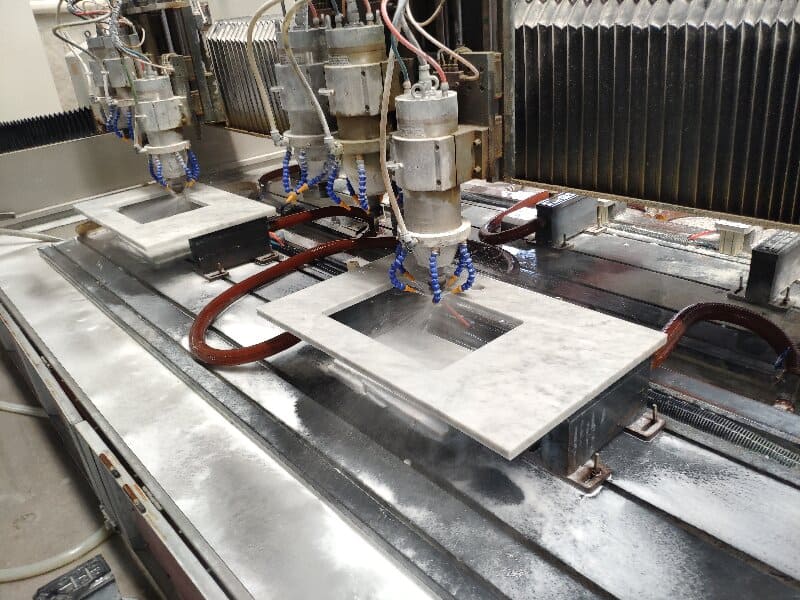
When you walk into the factory, look closely at the cutting machines. Are they rusty or new? At Lifeng Stone, we use infrared bridge cutting machines. This matters because manual cutting is often crooked. If the cut is not straight, the tiles will not line up on the floor. You will have big gaps, and your client will complain.
Next, check the polishing line2. Automatic polishing heads apply even pressure. This makes the shine consistent across the whole slab. Hand polishing is okay for small edges, but not for big surfaces. If you see workers polishing big slabs by hand, the reflection will be wavy.
You must also ask the factory manager: "What is your daily output?" If they hesitate, be careful. A real manufacturer knows their numbers. You need to know if they can finish your order on time.
Here is a simple checklist to use when looking at machines:
| Machine Type | What to Look For | Why it Matters |
|---|---|---|
| Bridge Cutter | Infrared guide laser | Ensures straight cuts and square corners. |
| Polishing Line | Number of grinding heads | More heads mean a higher, clearer gloss. |
| CNC Machine | Computer control screen | Essential for complex shapes and sink cutouts. |
| Water Jet | High-pressure nozzle | Needed for intricate mosaic or pattern work. |
Also, look at the floor. Is it full of mud and waste? A clean factory usually means a disciplined team. If they take care of their machines, they will likely take care of your order. If the machine maintenance is bad, the breakdown risk is high. This leads to production delays that you cannot afford.
What Quality Control Processes Should You Look For?
Cracks in stone are a nightmare for installers. If the factory misses them, you lose money on replacements. How can you trust their inspection team is doing their job?
Watch the inspectors in action. They should check for thickness, color variation, and physical defects. A reliable supplier marks defects clearly on the slab. Ask them to demonstrate their testing methods, like the sound test for internal cracks3.
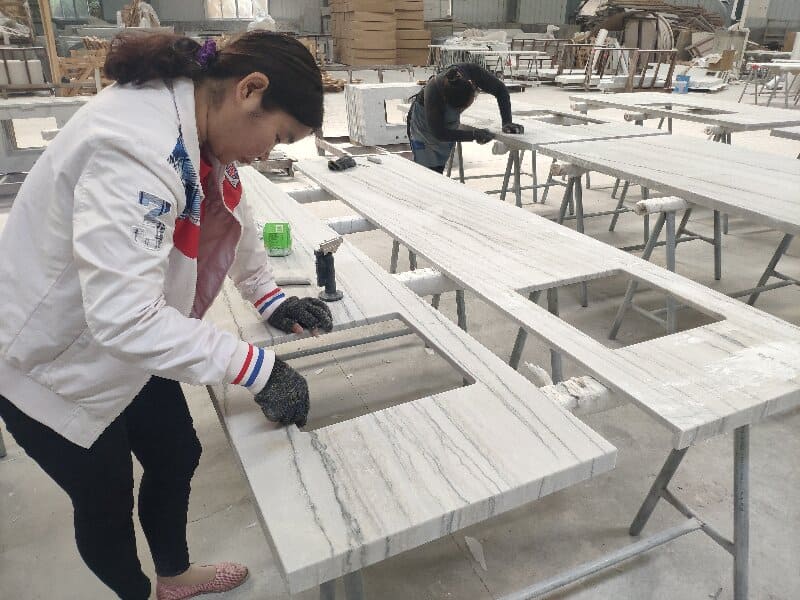
I remember a specific time when a client from the US visited our factory in China. He was very serious. As soon as he entered the workshop, he took out his phone and started taking photos. He asked me, "Can I see how workers check the stone?"
I took him to the inspection area. A worker was holding a hammer. He was tapping a stone slab gently. He was listening to the sound to judge if there were cracks inside. The client watched very carefully. Suddenly, he smiled. He told me, "This reminds me of my father. He fixed pianos. He also used his ears to tell the difference in sound."
At that moment, I realized something important. People from different cultures understand quality in their own ways. So, I asked the worker to let the client try it. The client tapped the board a few times. He heard a crisp, clear sound. His eyes lit up. He said, "I didn't know judging stone could be so intuitive!"
This experience made him trust our process completely. Later, he wrote in an email: "A truly good supplier does not just show products. They are willing to let me participate in the quality verification process."
You should look for this openness. When you visit, do not just read the paper report. Look at the slabs. Do you see chalk marks or tape? That is a good sign. It means the inspectors are finding problems before the stone leaves the factory.
Here are the specific QC steps you should demand:
- Thickness Check: Use a caliper. Check the corners and the center. The tolerance should be less than +/- 1mm.
- Dry Lay: For flooring projects, ask the factory to lay out the tiles on the ground. Check if the veins flow together correctly.
- Gloss Meter: Don't just guess. Use a machine to measure the shine. It should usually be above 85 degrees for polished marble.
If a factory refuses to show you these steps, or if the inspection area is empty, walk away.
How to Assess Material Inventory and Storage?
Running out of stone halfway through a project is a disaster. You cannot match the color later. Does the supplier actually have enough blocks in stock?
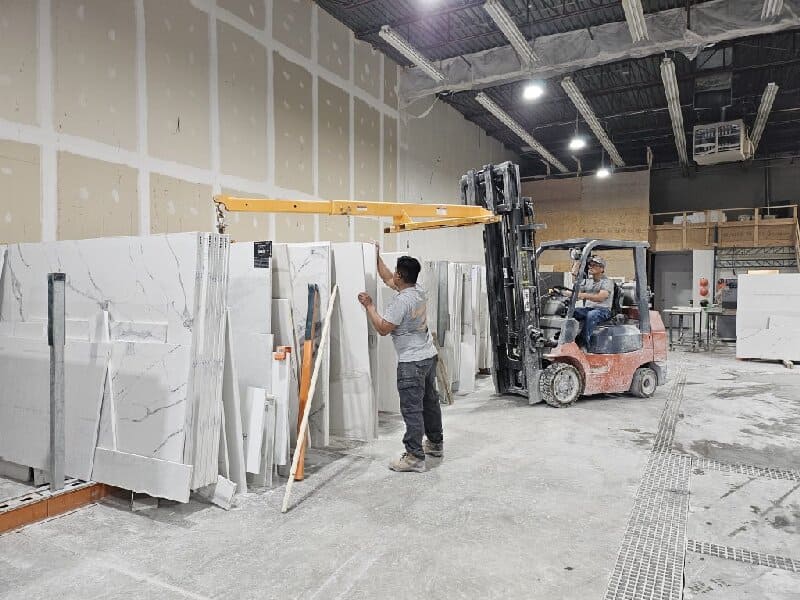
Visit the block yard and slab warehouse. A large inventory shows financial stability and ensures color consistency for big projects. Check if slabs are stored indoors to prevent weather damage and if they are organized safely.
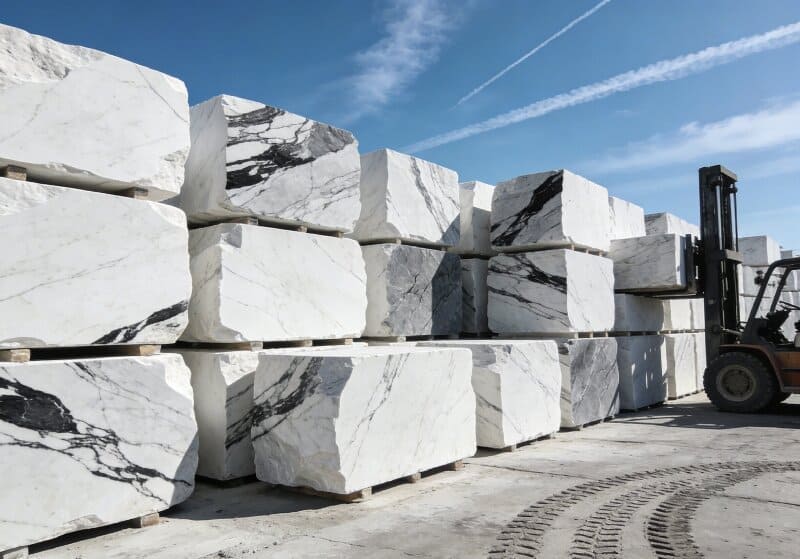
Go to the back of the factory. Look at the raw blocks. Are there many? If the yard is empty, the factory likely acts as a middleman or buys blocks only when they get an order. This is risky for you. Stone prices change every week. If they do not have stock, they might ask you for more money later. Or worse, the quarry might run out of that specific color.
At Lifeng Stone, we keep a large stock of popular blocks. This allows us to start cutting immediately. It also means we can control the quality from the very beginning.
You must also look at how they store the slabs. Are they leaning on A-frames? Are the frames strong? I have seen factories where slabs are stacked against walls. This causes warping. Warped slabs are impossible to install flat.
Also, check if the storage is indoor or outdoor. Some stones, especially white marble, are sensitive. If they sit in the rain and sun, they can turn yellow. They can also absorb dirty water from the ground. A professional factory invests in a roof to protect your investment.
Use this table to rate their storage:
| Storage Factor | Good Sign | Bad Sign |
|---|---|---|
| Block Quantity | Hundreds of blocks | Empty yard or very few blocks |
| Slab Protection | Covered warehouse | Exposed to rain and direct sun |
| Organization | Labeled by bundle number | Mixed colors and sizes |
| Safety | Strong iron frames | Wood sticks or leaning on walls |
Finally, ask about "exclusive" materials. A strong manufacturer often has special agreements with quarries. This gives them access to the best blocks before anyone else. If they have unique materials in the yard that other factories do not have, it proves they have power in the market. This gives you a competitive advantage when you sell to your clients.
Conclusion
To evaluate a supplier, inspect their machines, test their QC process yourself, and check their block stock. These steps ensure you choose a partner who delivers quality and reliability.